

When a tooth has decay, damage, or an older restoration that needs attention, there may be more than one way to restore it.
A dentist might recommend a filling, inlay, onlay, overlay, or crown depending on how much healthy tooth remains and which parts of the tooth need support.
The choice is not based on a simple rule that a small cavity gets a filling and a large cavity gets a crown. The location of the damage, involvement of the chewing cusps, existing restorations, bite forces, and overall condition of the tooth can all affect the recommendation.
Understanding the basic differences can make it easier to see why two seemingly similar teeth may need different restorations.
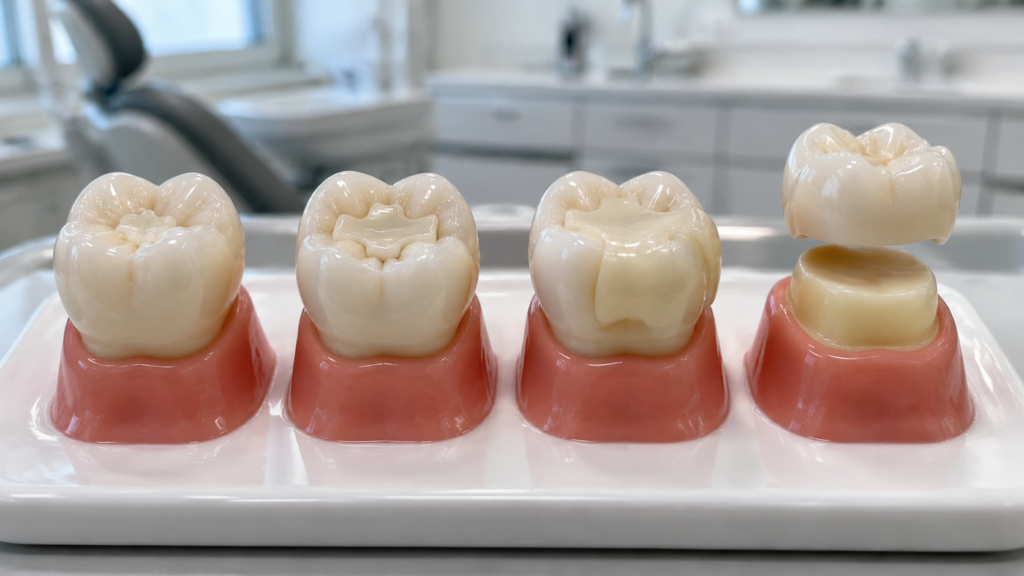
How Are Fillings, Inlays, Onlays, and Crowns Different?
These restorations differ mainly in how much of the tooth they replace or cover.
| Restoration | General Coverage | When It May Be Considered |
| Filling | Repairs a localized prepared area | Enough healthy structure remains for a direct restoration |
| Inlay | Fits within the cusps | Damage is more extensive but remains contained within the cusps |
| Onlay | Covers one or more cusps | A cusp needs additional coverage without necessarily covering the entire tooth |
| Crown | Provides broader coverage around the tooth | More extensive structural support is needed |
An overlay may provide broader partial coverage than a traditional onlay, depending on which portions of the tooth need protection.
These descriptions are general guidelines, not rigid treatment rules. The actual recommendation depends on the individual tooth.
When Might a Filling Be Enough?
A dental filling is placed directly into a prepared area after decay or damaged material has been removed.
A filling may be appropriate when the affected area is relatively localized and the surrounding tooth remains strong enough to support the restoration.
Your dentist may consider:
- How much healthy tooth structure remains
- Where the damage is located
- Whether the chewing cusps remain strong
- How much pressure the tooth receives
- Whether an existing restoration is present
A filling is not automatically the best option simply because the original problem began as a cavity. The remaining structure matters just as much as the material that needs to be replaced.
When Might an Inlay Be Considered?
An inlay is an indirect restoration that fits within the cusps of the tooth.
Unlike a traditional filling that is shaped directly in the prepared tooth, an inlay is fabricated to fit the area being restored.
An inlay may be considered when the tooth needs more than a straightforward filling but the damage remains contained enough that the cusps do not require broader coverage.
The key question is whether the remaining tooth can adequately support that type of restoration.
When Might an Onlay or Overlay Be Considered?
An onlay extends over one or more of the tooth’s chewing cusps.
This can make it useful when the damaged area is too extensive for a filling or inlay and a cusp needs additional protection, but the tooth does not necessarily require full crown coverage.
An overlay can provide broader partial coverage depending on how much of the chewing surface and cusps need restoration.
The distinction is not based only on cavity size. A dentist also evaluates where the weakened structure is located and which parts of the tooth need support.
When Might a Crown Be Needed?
A dental crown provides more extensive coverage around a prepared tooth.
A crown may be considered when a tooth has lost enough healthy structure that a filling, inlay, or onlay would not provide appropriate coverage.
Situations that may influence the decision include:
- Extensive decay or structural damage
- Multiple weakened cusps
- A large existing restoration
- Certain cracks or fractures
- Significant loss of healthy tooth structure
- Functional demands that affect the weakened tooth
A crown is not automatically required for every large cavity.
The dentist still needs to evaluate how much healthy tooth remains and whether a less extensive restoration can appropriately address the problem.
What Factors Help Determine Which Restoration You Need?
The final decision usually comes from several findings rather than one measurement.
Remaining Tooth Structure
One of the most important considerations is how much healthy enamel and dentin remain after decay or damaged material is removed.
A tooth with substantial healthy structure may support a filling or partial-coverage restoration. A more extensively weakened tooth may need broader protection.
Location and Extent of Damage
Damage in the central portion of a tooth may be treated differently from damage that extends toward an edge or chewing cusp.
Two cavities of similar visible size can therefore lead to different treatment recommendations.
Cusp Involvement
Cusps are the raised portions of back teeth that help with chewing.
If a cusp has become thin, fractured, or undermined by decay or an old restoration, additional coverage may be considered. This is one reason an onlay or crown may be recommended instead of simply extending a filling.
Existing Restorations
A tooth that already contains a large filling may have less natural structure remaining if new decay or damage develops later.
The dentist evaluates both the restoration and the tooth around it before deciding whether the existing filling can remain, should be repaired, or should be replaced.
Bite and Chewing Forces
A restoration also needs to function when you bite and chew.
How the tooth contacts the opposing teeth and the forces placed on it can therefore be part of treatment planning.
Heavy forces alone do not automatically mean a crown is necessary. Bite function is considered together with the condition of the tooth.
Is a Less Extensive Restoration Always Better?
Not necessarily.
Conservative dentistry is not simply about choosing the smallest restoration possible. It means preserving healthy tooth structure when appropriate while still providing enough support for the tooth.
If a filling can adequately restore the damaged area, there may be no reason to use a more extensive restoration.
If one or more cusps need additional coverage, an inlay may not provide enough protection, while an onlay or overlay may be appropriate.
If the remaining tooth requires broader coverage, a crown may make more sense.
The goal is to match the restoration to the actual structural and functional needs of the tooth rather than assume that less coverage is always better.
What About Gold Inlays and Onlays?
Gold is one material that can be used for certain indirect restorations.
For appropriate cases, we offer gold inlays, onlays and overlay restorations.
Material selection can depend on the tooth being treated, restoration design, location, functional demands, and patient preferences.
Gold is not automatically the best material for every patient or every tooth. It is one restorative option that may be considered when it fits the treatment plan.
What If More Than One Restoration Could Work?
Sometimes more than one option may be clinically reasonable.
For example, the condition of a particular tooth might allow more than one type of indirect restoration.
When that happens, your dentist can explain factors such as:
- How much tooth structure each option preserves
- How much coverage the tooth needs
- Material choices
- Treatment process
- Functional considerations
- Maintenance
- Your preferences
Patient involvement is important when there is a meaningful choice between appropriate options.
Our approach emphasizes patient education so you can understand why a treatment is being recommended before deciding how to proceed.
What Questions Should You Ask Your Dentist?
If more than one restoration is being discussed, asking a few specific questions can help you understand the recommendation.
Consider asking:
- How much healthy tooth structure remains?
- Why are you recommending this restoration?
- Could a less extensive restoration work?
- Does one or more cusps need additional coverage?
- What alternatives would also be reasonable?
- What should I expect from treatment and ongoing care?
The goal is not to choose a restoration based on its name. It is to understand what the tooth needs and why one option may fit that situation better than another.
The Right Restoration Depends on the Tooth
A filling, inlay, onlay, overlay, and crown each provide a different level of restoration and coverage.
A filling may work when the damaged area is localized and enough healthy structure remains. An inlay may be considered for a larger contained area. An onlay or overlay can provide additional coverage when one or more cusps need protection. A crown may be appropriate when the tooth requires broader structural support.
There is no single restoration that is right for every damaged tooth.
At Dental Partners of Creve Coeur, we focus on understanding the condition of the tooth, explaining the available options, and choosing treatment based on your individual needs.
If you have been told that you need a filling, inlay, onlay, or crown and want to better understand your options, contact us to schedule an evaluation.


